Thirty years at the bench.
Richard Stephenson 'Richie' has spent more than thirty years working wood — as a luthier, a carpenter, and a traditional timber framer. It is unusual training for an instrument maker, and it shows: he reads timber the way a framer must, knowing how a tree becomes a beam, and a beam a soundboard.
His workshop is in Llanfyllin, in the hills of northern Powys — a room that smells of shavings and warm oil. His home, and much of his timber, lie a few miles north at Llanrhaeadr-ym-Mochnant: fitting country for the work, for Llanrhaeadr was the parish where, in 1588, William Morgan first put the whole Bible into Welsh and so helped keep the language alive — the same long instinct, to carry an old thing safely into the next pair of hands, that keeps the crwth and the telyn sounding.
He builds slowly, by hand, favouring Welsh timber and traditional methods, because the instruments he makes were never meant to be hurried. Every commission begins with a conversation and ends with an instrument made for one player alone.
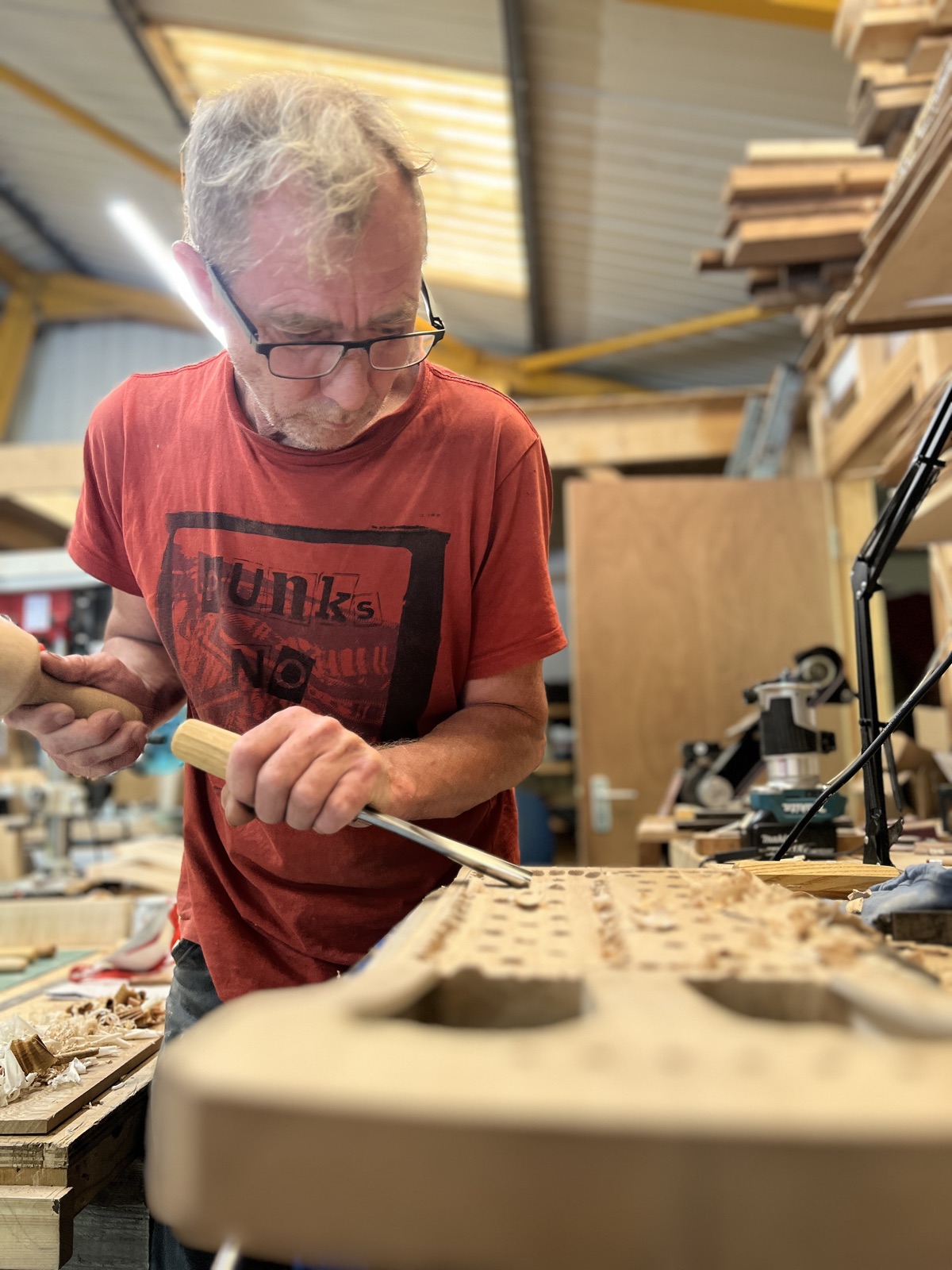
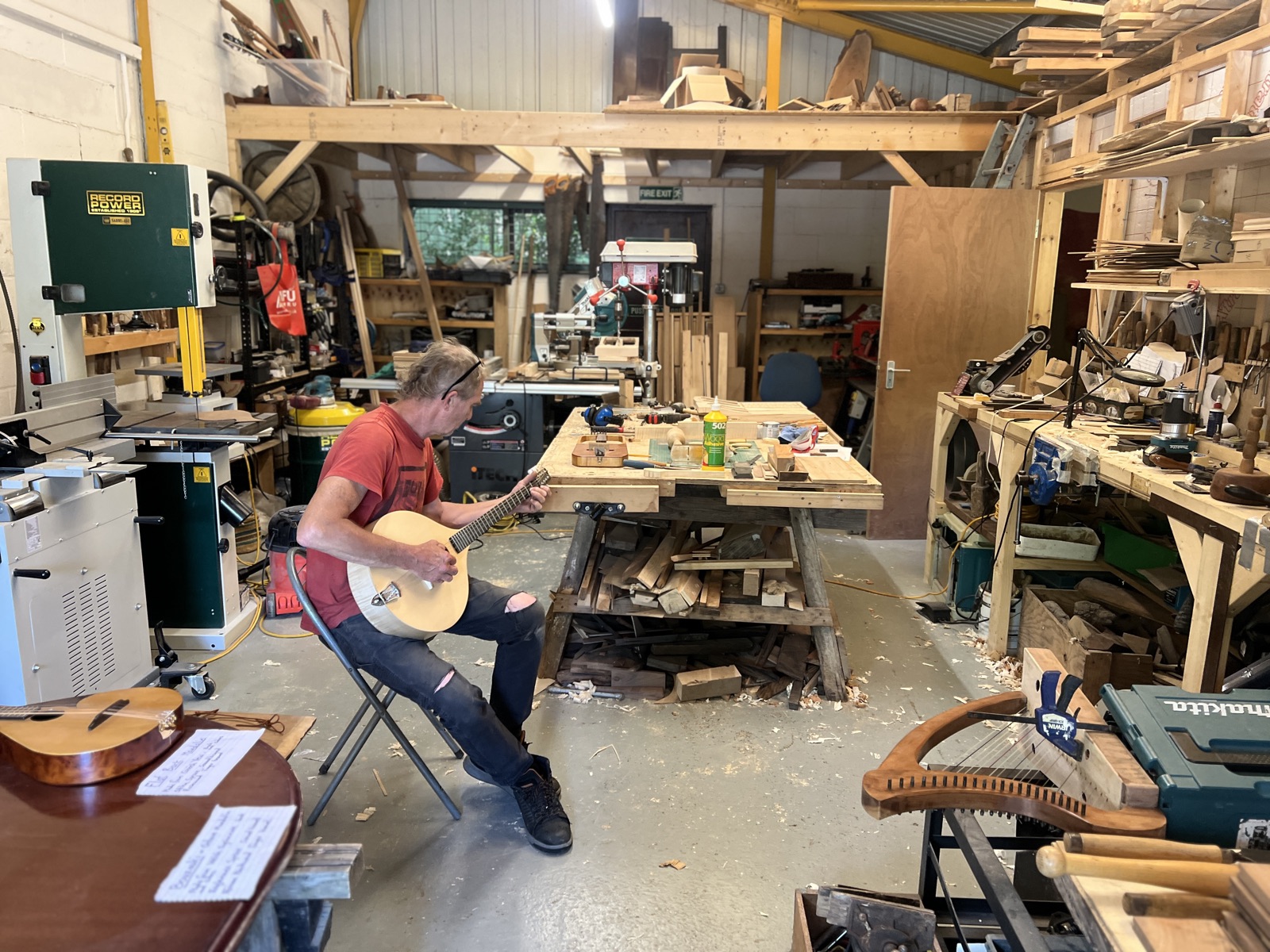
The workshop — Llanfyllin
From the tree to the beam to the soundboard.
Before he made anything that sang, Richie made things that stood. Thirty years of carpentry and traditional timber framing taught him the long grammar of wood — how an oak grows, how it moves, how it wants to be cut so that a green beam will settle true a hundred years after it is raised. A framer cannot rush this. The timber answers on its own time or not at all.
It is unusual schooling for a luthier, and it changed how he hears a board. Green-wood work is patient work: you take the tree while it is still wet, and you let it dry into the shape you have given it, coaxing rather than forcing. A soundboard is only a beam thinned almost to breath — the same tree, the same reading of the grain, the same refusal to hurry, brought down to the thickness of a voice.
So the chain is short and unbroken. A tree in a Welsh wood. A beam squared under the plane. A soundboard tuned by ear until it gives. Richie has stood at every link of it, and he builds instruments the way he framed roofs — knowing that if the timber is honoured early, the work will hold long after he has set down the tools.
"An instrument doesn't ask to be hurried. It asks to be listened to — first the timber, then the tools, then the room it will end up in. If you get those three right, the voice will come of its own accord."
— Richard Stephenson
A craftsman at his craft.
The old Welsh had a phrase for it — gwŷr wrth gerdd, "a craftsman at his craft," or more nearly, one who is skilled in his art. It named the makers and the musicians together, and made little distinction between them: the hand that shaped the instrument and the hand that played it were held to the same standard of care. Richie would not claim the title for himself. But it is the standard he keeps — the timber first, then the tools, then the room the instrument will end up in, and the awen, the muse, left free to arrive in its own hour.
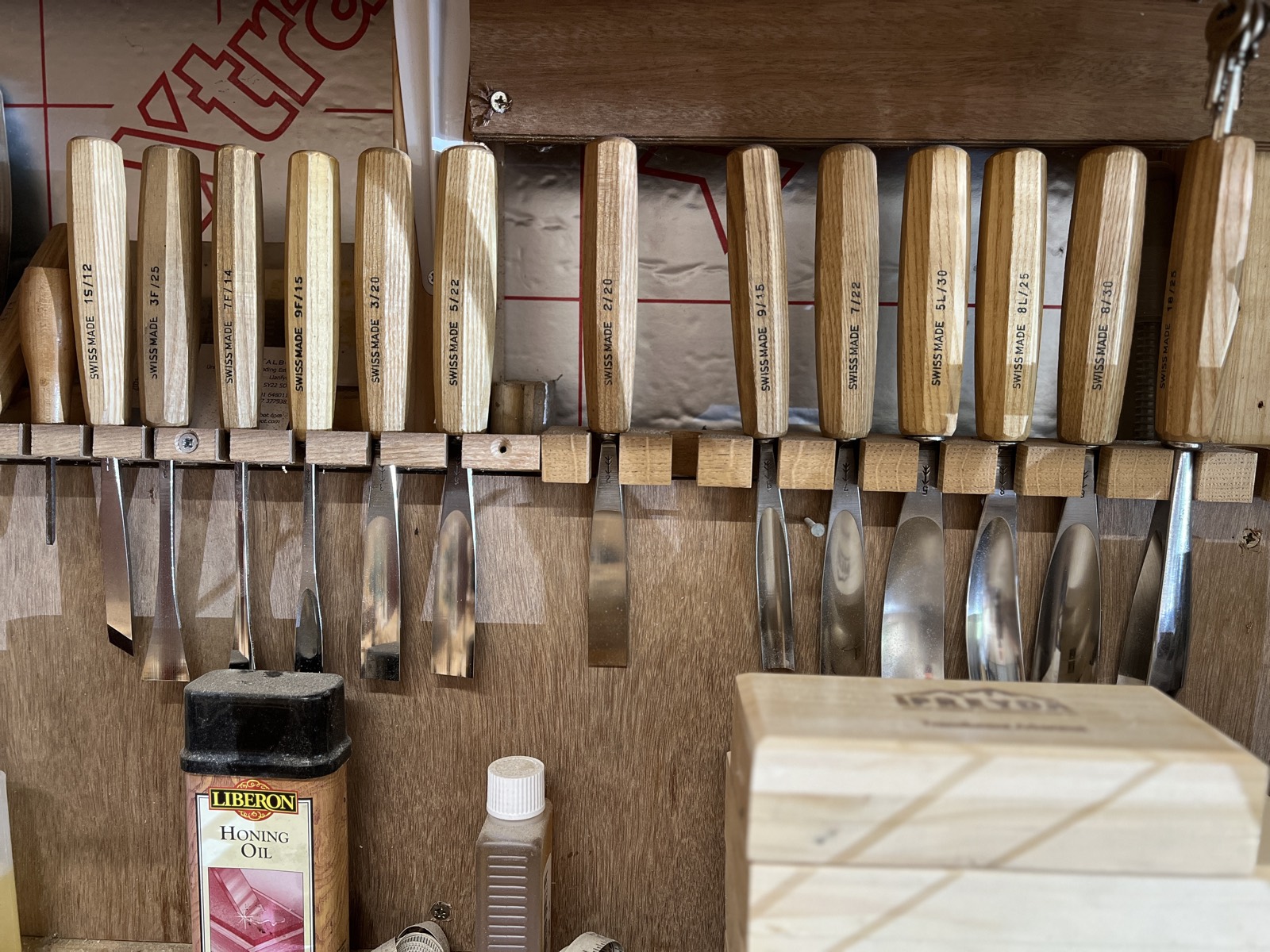
The tools — kept sharp, and to hand
The wider tradition.
A maker works within a living tradition of players, scholars, and keepers of the old music. A few of the people and places that hold it together.
- Clera
The society for the traditional instruments of Wales — those gwŷr wrth gerdd, the folk skilled in music, for whom these instruments are made.
- Trac Cymru
Folk development for Wales — the sessions, the workshops, and the young players carrying the tunes on.
- Llyfrgell Genedlaethol Cymru — the National Library of Wales
Its Welsh Music Archive keeps the written record of the awen — the poetic gift — and the music the harp and crwth were made to carry.